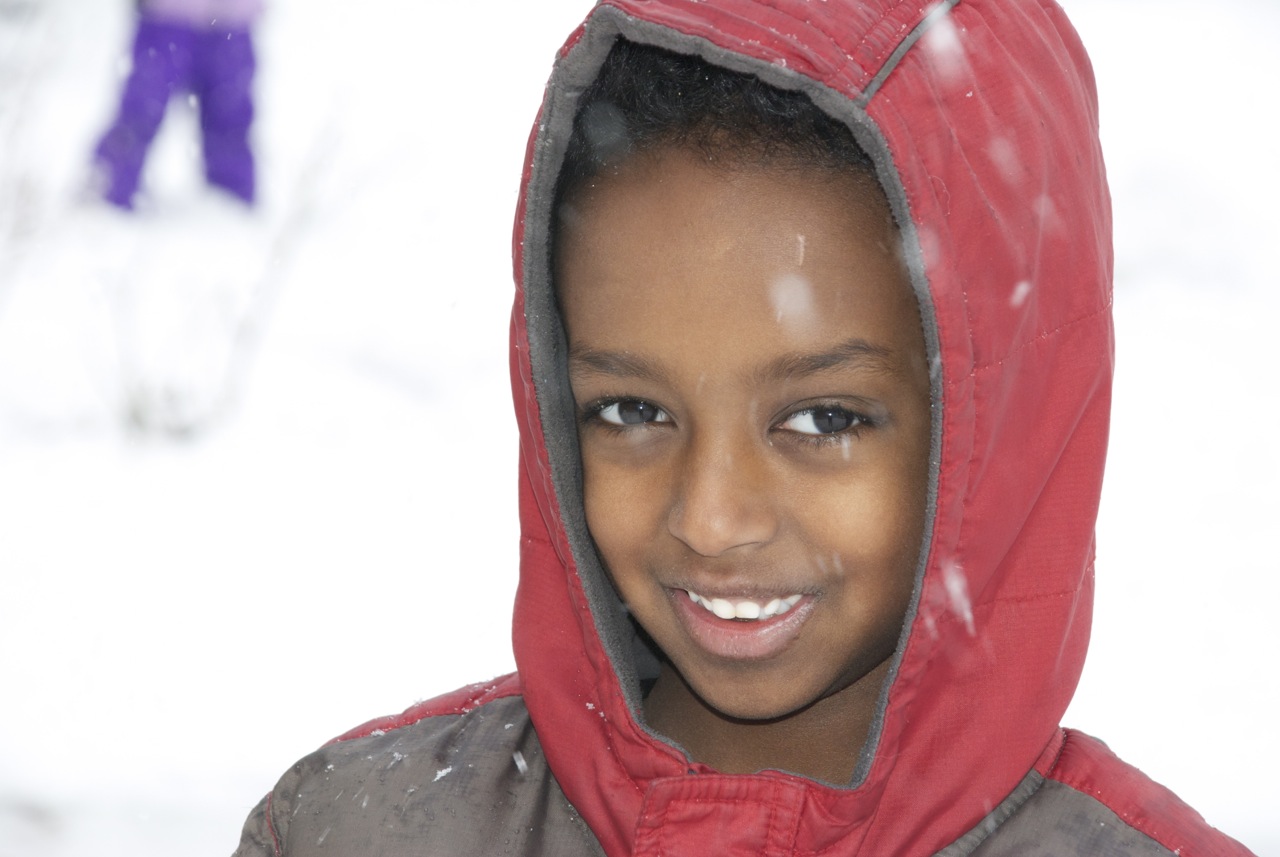
My Trayvon

DSC_0032

I look into these dark brown eyes and wonder “when does this sweet face turn into a dangerous face?”  At what point does  my sweet baby boy turn into someone who is feared?  At what point will those who comment on his manners or his personality start to view him with suspicion?  At what point does he stop being human and start being black?

These are hard questions.  There isn’t a manual on how to raise a child, much less a black male child (if there is, please leave a link in the comments).  We knew when we adopted our children that this would be something we would have to figure out.  To learn how to raise our son (and daughter–but that’s a different post) so he values who he is, but also knows what others may think he is.  He’s only 7 now, but these are conversations we have.  He has been acutely aware since an early age that he is different.  He asked me at 3 if the other kids are the part would think he was different because his skin was brown.  This is something he strives to process and understand.

He wishes he was white.  He does that at the age he is now because he wants to be just like his dad.  We work through that by pointing out all of the similarities the two have.  It makes Noah more comfortable with the differences if he realizes the similarities.  My 7-year-old can process that.  Why can’t others?

I am tired of hearing that things are better than they use to be as far as race is concerned.  Yes they are better.  I am not discounting that progress has been made.  But I call bullshit that the progress is enough. We can’t be complacent and treat it as if it isn’t a problem.  As if it isn’t something that erodes progress.  As if race doesn’t matter.  Because race matters.

We watched 42 last night and I cried.  I cried that Jackie Robinson had to endure what he did to prove the value of a black man.  I cried that Branch Rickey learned a lesson about not standing up and tried to do right.  I cried that Jackie Robinson would have waited until his teammates were done showering, so that he wouldn’t make them feel uncomfortable.  I cried because someday Noah will make someone nervous enough in a parking lot they will grip their mace and be ready to spray him.  I cried because someday Noah will make someone nervous in an elevator that they might not get off on their floor for fear of being followed.  I cried because someday Noah will go to pick up a girl for a date and her parents won’t let her go.  I cried because when Noah experiences these things, I won’t know what to say.  I won’t be able to understand how he feels.  I will be able to love him and listen.  I will know that just because I didn’t experience these things, they do exist.  I will allow him to give voice to how he feels.  I will love him.  I will listen.

That we live in a world where black men must be taught to be submissive to others for fear of their own life, makes me profoundly angry and sad.  That my son will stop being human and start being black is unfair.

My son will one day walk home on a dark rainy night.  I pray that someone offers him a ride instead of assuming he is up to no good.

I Didn’t Understand Then But Do Now

Dear Justin,

I am sorry it took the shooting of Trayvon Martin for me to understand what you said all those years ago.  I am sorry I didn’t see your wisdom of experience.  I was too naive to understand.  I was too stuck in my own world of white privilege to really hear you.  And for that I am sorry.  You asked a question that seemed absurd to me in 2006, before I brought my Ethiopian son home.  We were in class and I remember the moment vividly.  I was telling the class about our impending adoption of a child from Ethiopia.  We had just received our referral and knew we were going to have a son.

The class was asking questions and then you asked me “who is going to teach him how to be black.”  At that moment, that questions seemed ridiculous.  I turned it into a  teachable moment, to discuss what it really meant to be black (ridiculously, white–I understand that now).  I challenged you in your question.  I talked about how my son’s world would be one of middle class suburbia and private schools.  Just thinking back on this moment, I am filled with shame.  I thought I was your ally.  I thought I understood what your live was like to some extent.  But I looked at your life through my own lens of privilege.

I was naive to think that my privilege would somehow make my son’s skin color less noticeable.  That some how the fact that we are upper-middle class affords him the ability to be both black and privileged.

I was so wrong.  I wish I had really heard your question.  I wish I had listened instead of trying to teach from my perch of privilege.  How foolish I was.  How naive I was.  How wrong I was.  How sorry I am that I trivialized your experience and what it means to be black.  That it even meant something at all to be black. I could have learned so much.

************************************************

I spent  years working in urban schools with a majority black student population, before I left teaching in 2006 to stay home.  I was “enlightened.”  I will admit I uttered the words “I don’t see color, I see students.”  I can also now admit that that statement is an utter lie.  Of course, I saw skin color; the color just didn’t matter to me.  And it should matter.  But I can’t live with my head in the sand and pretend it doesn’t matter.  Because now, as the mother of two black children, it matters immensely.

It mattered when he was three and we were walking to the park in our 95% white neighborhood and he asked “mom will the other kids think I am different because my skin is brown?”  It mattered when he was watching a play at a community theater with a group of friends –who were all white–and he was the only one told to be quiet for talking.  It will matter when he asks a white girl out and her parents forbid it.  It will matter when he forgets his house key and climbs through the front window.  It will matter.

The death of Trayvon Martin is a tragedy.  He should still be alive.  His parents should still have him to scold, guide and love.  The death of Trayvon Martin is a wake-up call.  The murder of Trayvon Martin has shaken me to the core.  Trayvon is my son.  My son is too young to know what happened to Trayvon.  He is only 5.  But he can see injustice in being singled out to be quiet when it other friends are doing the same thing he is.

I’ll never understand what it is like to be black.  But I have to mine all the information I can, so that my son can know what it means to be black in our bigoted and prejudicial society.  How to be black in a world that will look at him in his teen and young-adult years and see danger and suspicion.

Jesse Washington wrote:

As I explained it, the Code goes like this:

Always pay close attention to your surroundings, son, especially if you are in an affluent neighborhood where black folks are few. Understand that even though you are not a criminal, some people might assume you are, especially if you are wearing certain clothes.

Never argue with police, but protect your dignity and take pride in humility. When confronted by someone with a badge or a gun, do not flee, fight, or put your hands anywhere other than up.

Please don’t assume, son, that all white people view you as a threat. America is better than that. Suspicion and bitterness can imprison you. But as a black male, you must go above and beyond to show strangers what type of person you really are.

It is my responsibility as a white parent of two black children, to teach them what their skin color means and how it might effect their lives.  I have to push aside my privilege and really look at what happens in our world. I have to admit that my privilege does not transfer to my children.

I am so sorry that it took another mother losing a child for me to fully understand that question Justin asked nearly 6 years ago.  I have an answer now–Who is going to teach my son to be black?  Well, I have to.  I. Have. To.  I have saved nearly every piece of writing on Trayvon Martin, by those of color who articulate, however painful it might be, what it means to be a black man in America.  It might be my most important role. It might help my son navigate the world.


My Worst Nightmare

Trayvon Martin‘s story could one day be my son’s story.  Like Trayvon, my son is black.  Right now it doesn’t affect his life much–but one day (in 11 years) he’ll be a 17-year-old black man walking the streets in a predominately white neighborhood.  By virtue of his skin color, he will be suspicious.  I thought I had come to grips with this.  I thought I was prepared.

I am not prepared for the possibility that my son could be the victim of this type of crime.  Trayvon did nothing wrong.  The man who shot him wanted to shoot him.  The man who shot him hunted him down.  The man who killed him, felt that he was justified.  That is what scares me the most.  What happens when Noah forgets his key and climbs through the front window our house in our mostly white neighborhood?  I haven’t forgotten about what happened to Henry Gates at his own home in Cambridge.

I struggle for the words to express my fears for my son.  You think the world is different and has changed, when in reality that is something we tell ourselves to feel better.  We live in a pretty isolated world.  My kids go to private school with people who love them and see them as people.  They have family and friends who love them.  But events like this break the illusion.  Events like this make me question how we allow things like this to happen. Events like this make me realize that race matters; perhaps even more now than previously.  Race matters more now, because we have become complacent.  Race matters because so many people think it doesn’t.  It matters to Trayvon and his family.  It matter to the man who shot and killed Trayvon simply because he was black and perceived to not belong.

It is time that all of us stood for justice.  This isn’t just an issue for the black community to take a stand on.  This is an issue for all of us to take a stand on.  By doing nothing, by not acting we send the message that Trayvon doesn’t matter.  By doing nothing, by not acting we say to all other black males–you deserve what you get.  That is not a message I will send to my son.  That is not a message I will send to someone else’s son.  Everyone matters.  And it is time we stand up and shout “Being Black doesn’t make someone guilty, suspicious or dangerous.”

I live with immense privilege.  I accept that privilege, but with it comes a responsibility.  My son and daughter enjoy some of the privilege that I have.  But as soon as they are old enough to be out on their own–the privilege disappears.  Because of this, I cannot afford to be complacent.  I cannot afford to turn a blind-eye when injustice happens.  I cannot afford to let my children think that their skin color doesn’t matter.  Because it does to so many people.  Because it will be the first thing people judge them by.  Because it will lead to my son and daughter being followed through the store as they shop with friends.  It will lead to other parents not wanting their child to date mine.  It will lead to my son being pulled over as he leaves a friends house on a Friday night.

We can’t stand by and allow it to be okay.  We have to be aware of our own bias and actively fight against it.

Today, I stand in solidarity with Trayvon Martin’s family. Today, I stand with my son.